

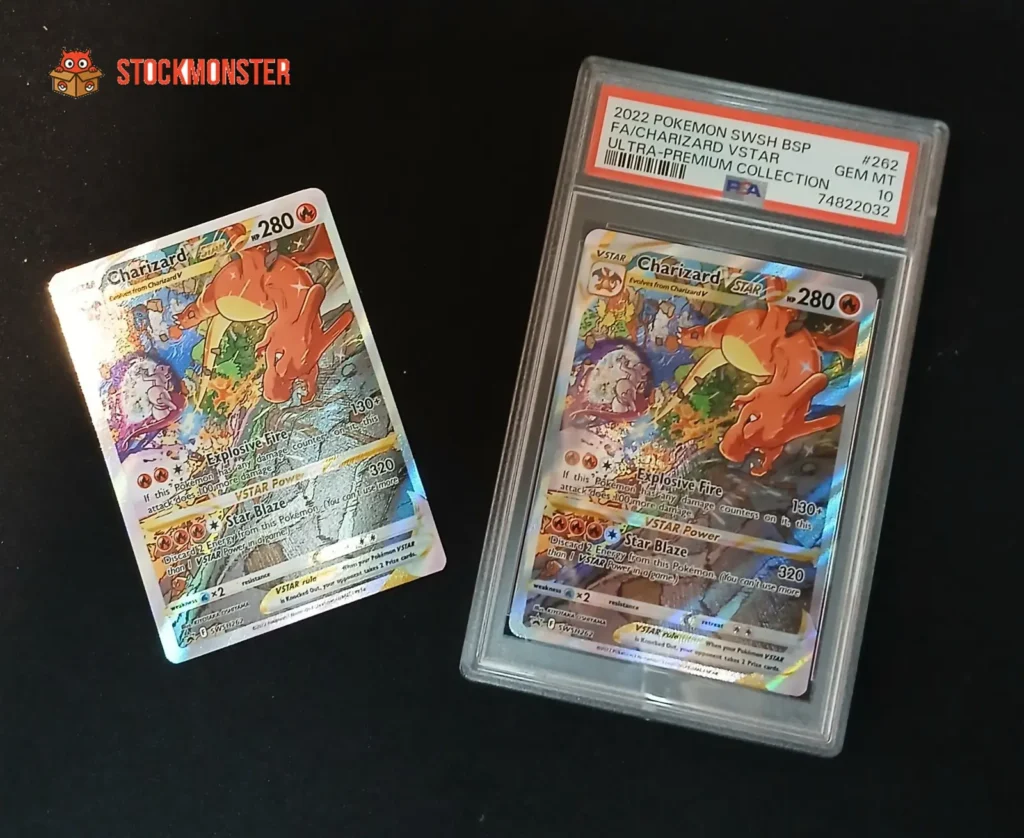

You pull a beautiful card out of a booster and almost immediately the question comes: should it go to PSA? The same thing happens to vintage cards. The map may not be perfect, but it is valuable, rare or important to your personal collection.
Pokémon cards letting degrees can certainly be interesting, but it is not automatically the best choice. A bib does not automatically make a card worth more and a card coming directly from a booster does not get a 10. Pokémon cards leave degrees
My short answer is therefore: Don't leave a card degrees until you know why you're doing it.

What happens during the temperature?
For professional grading, the card is first checked if it is authentic. The condition is then assessed and the card gets a digit. The card is then placed in a sealed plastic container. Pokémon cards leave degrees
PSA uses a scale of 1 to 10. The assessment will focus on the centering, corners, edges and the surface of the card. The general appearance also plays a role. Pokémon cards leave degrees
According to the official explanation of PSA a PSA 10 is almost perfect. A PSA 9 is almost perfect, but may have a small imperfection. For example, this can be a slight deviation in the centering, a small production error or minimal damage to an edge or angle.
That difference sounds small, but with popular Pokémon cards it can cause a huge difference in market value.
Why do you want to get the map degrees?
Before looking at prices and possible figures, you have to decide what your goal is. Grades for your own collection is something other than degrees to make a profit.
Maybe you want to protect a special card and present it nicely. In that case, the financial calculation does not have to be perfect. A bib can be nice for a card with emotional value, even when the grading costs are higher than the possible increase in value. Pokémon cards leave degrees
If you want to sell the card later, the expected grade becomes much more important. The value after grading must then be sufficiently higher than the current raw value and all additional costs.
Grading can also be interesting for vintage cards where authenticity is important. Even a lower digit can add value when buyers get more certainty about the authenticity and condition. Pokémon cards leave degrees
PSA 9 or PSA 10 makes a big difference with modern cards
For modern Pokémon cards, a PSA 10 is usually the desired result. Many modern maps are still relatively easy to find in raw Near Mint condition. As a result, the market does not always pay a large additional price for a PSA 9.
Suppose a raw card is worth €100, a PSA 9 about €120 and a PSA 10 €275. When you include all the grading, shipping and insurance costs, a PSA 9 can hardly be financially interesting. The potential profit is then almost entirely in achieving a 10.
This is just a calculation example. Always check recent sold copies of exactly the same card and the same grade. Don't just look at demand prices. A card can be offered for months at a high price without anyone actually paying that price.
With modern cards it is therefore wise to select strictly. If you already see clear whitening, bad centering, scratches or a damaged angle in advance, chances are that the financial calculation will be disappointing.
Vintage cards do not have to reach PSA 10
Vintage Pokémon cards work differently. A Base Set Charizard, 1st Edition Lugia or old Gold Star does not have to be PSA 10 to stay interesting.
These cards are harder to find in good condition and are also collected in lower grades. A PSA 5, 6 or 7 can still be attractive when the card is rare, has a nice look or simply falls within the budget of more collectors.
Grading can also confirm in vintage that the card is authentic and not recoloured, cut or otherwise modified. The bib also protects the card from further direct contact.
Check the population with expensive vintage cards. In the PSA Population Report you can see how many copies of a card have been reviewed in each grade. Please note that the same card may have been submitted several times, so population figures do not always equal the exact number of existing ones.
First check the full condition
A card can look perfect at the front and still not achieve a high grade. Therefore always look both sides under good and preferably oblique light.
Centering
Check that the edges around the artwork are approximately evenly distributed. View both front and back. A map with perfect angles and a clean surface can still lose points due to poor centering.
Angles
A small white dot on a rear corner can make all the difference between a possible 10 and a lower grade. Note also soft corners, slight nods and corners that stand slightly up.
Border
Look at the map on all sides. Whitening stands out quickly on a dark back, but slight damage to the front can be more difficult to see. Also check for indentations and an irregular factory cut.
Surface
Use oblique light to find scratches, print lines, dents and other damage. A small indent can count much heavier than a superficial scratch. Check holo-cards from multiple directions, as damage sometimes only becomes visible at a certain angle.
According to PSA, the weakest category can ultimately determine the final grade. For example, if the corners fit a 6 and the surface at an 8, the card can still get a 6. This is explained in the official rating of PSA.
Pack fresh does not automatically mean PSA 10
A common mistake is that a card must be perfect directly from a booster. Pokémon cards can already be damaged during production, packaging and transport.
Known problems are poor centering, whitening, blunt cutting edges, print lines, scratches and small dents. So you can get a card directly from a pack and still receive a PSA 8 or 9. Pokémon cards leave degrees
Therefore, treat a possible grading card with caution immediately. Place it in a clean sleeve and suitable semi-rigid card holder. Don't keep taking the card out of protection unnecessarily to revisit it. Each operation carries a small risk. Pokémon cards leave degrees
Don't forget all the additional costs
The grading price per card is only part of the total amount. You can also deal with shipping, insurance, return costs, import costs and a fee for an intermediary.
The chosen service and indicated card value can also influence the price. Current rates and lead times change regularly. Therefore always check it before sending cards.
Calculate in advance what the card is worth as PSA 8, PSA 9 and PSA 10. Then remove all costs. If only a 10 wins, you have to be pretty sure of the condition to find the risk justified.
Also consider market movements. A modern card can be popular when you send it, but are worth a lot less a few months later. Grading takes time and in that period the market can change. Pokémon cards leave degrees
Sometimes it is better to buy a graduated card instantly
Do you want a particular card purely for your own collection? Then compare what an existing graded copy costs first. Pokémon cards leave degrees
Sometimes a PSA 8 or PSA 9 is hardly more expensive than a nice raw card plus all grading costs. You know directly what grade you buy with an existing bib and you are not at risk of a disappointing result.
This is especially true when you are not specifically attached to the copy you own. If you have drawn the map yourself or if there is a personal story behind it, it can be fun to have your own copy graded.
Be careful with cleaning and repair work
Not every treatment is allowed within the rules of grading companies. PSA may refuse cards when there are indications of trimming, restoration, recoloring, alternated stock or cleaning. In case of different rejections, the full grading costs can be charged. This is in the official PSA explanation on No Grade results.
Coloring Whitening, cutting edges or hiding damage is a clear limit. Polishing, intensive scratch treatment and treatment of wrinkles can also be seen by a grader as adaptation or restoration.
No one can guarantee in advance that a treated card will be accepted by PSA or receive a certain grade. Therefore, be honest about treatments performed and don't be tempted by claims such as "Psa Safe" or "Safer" guaranteed a higher grade.
Cleaning or repairing a card with the aim to make damage invisible is something other than keeping a card dust free. In doubt, doing nothing is usually the safest choice. We have our own specialist from . . . . . . . . . . . . . . . https://stockmonster.en/kais-card-cleaning-detailing/
When is degrees probably interesting?
Grading can be interesting when a card is rare or valuable, authenticity plays an important role or the expected increase in value is well above the total cost. Pokémon cards leave degrees
Also for a personal grail, grading can be a nice choice. The financial value does not have to be decisive. Protection, presentation and the story behind the map could be more important to you than the number. Pokémon cards leave degrees
With modern cards, the condition should usually be exceptionally good. With vintage you can look more realistic at lower grades, because older and rare cards can also remain desired with visible traces of use.
When better not to?
Does a modern card have clear whitening, bad centering or surface damage and is only a PSA 10 financially interesting? Then sending in is probably mostly gambling.
Grading is also less logical when the raw value is low, there is little demand for graded copies if the total cost is almost equal to the value of the card.
Sometimes a card also hears in a binder. Not every beautiful Pokémon card gets better from a bib and not every collection has to consist of numbers.
Our advice: review the map and your purpose
Pokémon cards letting degrees is especially wise when the expected grade, market value and total costs fit well together. Not just look at what a PSA 10 is worth. Also calculate what happens when the card receives an 8 or 9.
For modern maps, strict preselection is important. With vintage cards, authenticity, protection and collect value can also be sufficient reason to submit at lower grades.
And maybe the most important thing: a grade is a professional assessment of the condition, but does not determine how much a card means to you personally. A youth card with traces of use can still feel much more valuable than any PSA 10.
Frequently asked questions about Pokémon cards degrees
How much does it cost to get a Pokémon card degrees?
The total cost depends on the grading company, the chosen service, the value of the card, shipping, insurance and any costs of an intermediary. Always check the current rates before sending in.
How do I know if my Pokémon card gets a PSA 10?
You can never know for sure before. Check center, corners, edges and full surface under good light. Even a card that comes directly from a booster can have production errors.
Is a PSA 9 worth more than a raw card?
That varies from one card to another. With some modern cards, a PSA 9 is hardly worth more than a nice raw one. For vintage or rare cards, PSA 9 can have considerable added value.
Is a low PSA grade in vintage bad?
Not automatically. Rare vintage cards are also collected in lower grades. Authenticity, appearance, scarcity and purchase price may be more important than achieving a 9 or 10.
Can a cleaned Pokémon map to PSA?
PSA may refuse a card when the company sees indications for cleaning, restoration or other modifications. No one can guarantee that a treated card is accepted.
Need some help? Ask our grading service
Are you questioning whether a card is suitable to leave degrees? Within the StockMonster Discord we have a grading service where you can get explanations and personal advice.
The grading service can explain how the process works, what grading options there are and what a card pays attention to. An assessment of the possible grade can also be made on the basis of clear photos or on-site assessments.
In addition, you can have the costs calculated in advance. So you know better whether grading for your card is financially interesting before making a decision.
An assessment remains, of course, an assessment. The final grade is always determined by the grading company and can never be guaranteed in advance. The service specifically helps you to start the process with realistic expectations.
Curious about our community of over 5000+ members? click here!


