


How do you determine the value of your Pokémon cards?
You got a nice Pokémon card in your hands. Maybe you just got him out of a package. Or you found your old collection in the attic. In both cases, the same demand emerges: what's this card worth, anyway?
A lot of beginners get stuck right here. Prices vary enormously per website, cards resemble each other but are different, and it is often unclear which source to trust.
In this guide you will learn step by step how to determine the value of your Pokémon cards. We show which factors influence price and which sources to use to find reliable prices. Then we apply this to two common situations.
What does the value of a Pokémon card depend on?
Before you look up prices, it's important to understand why cards have a certain value. In practice, this almost always amounts to three factors: rarity, condition and popularity.
Rare
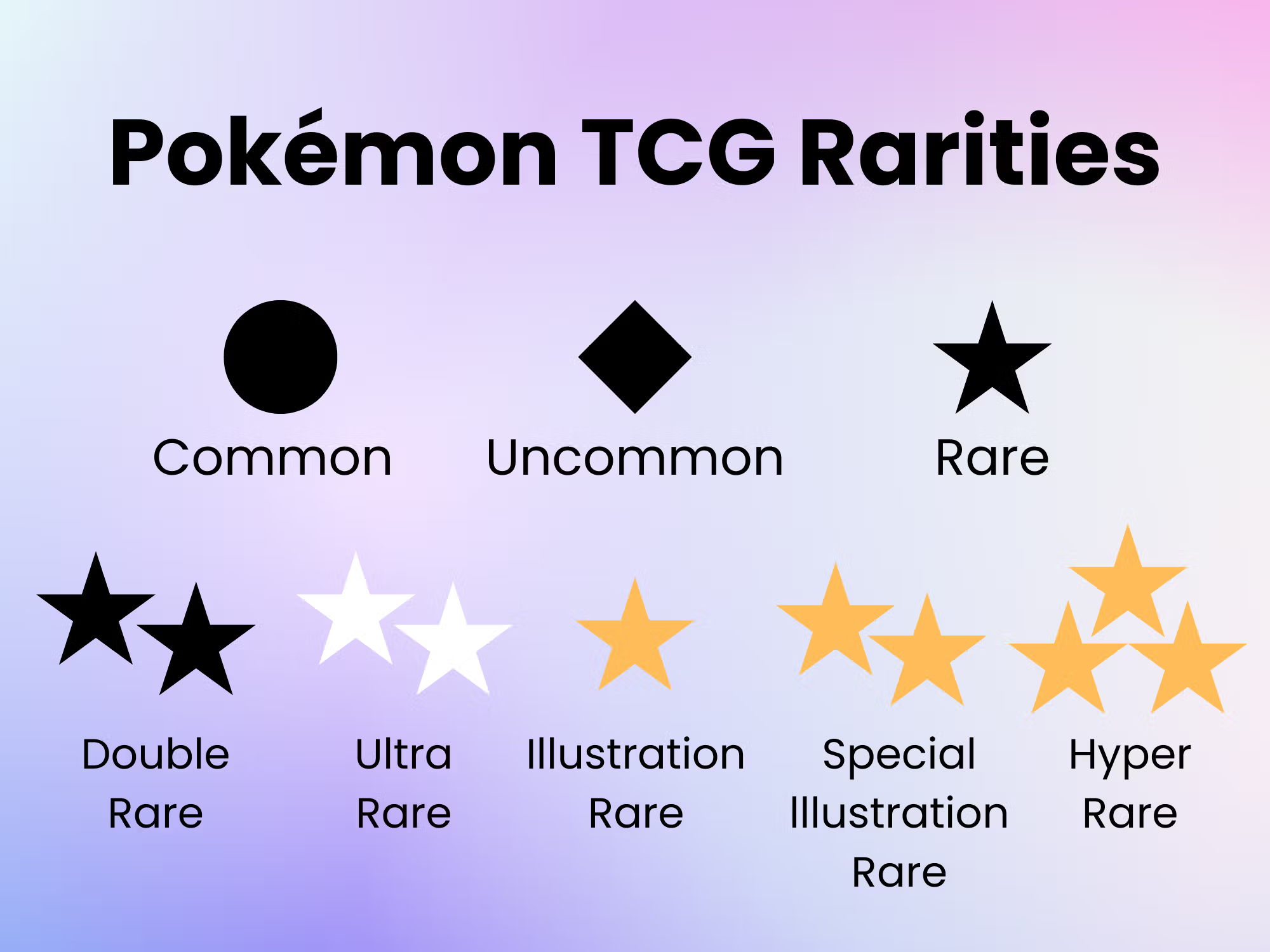
Not every card is as hard to get. The rarer a map, the more likely it is to be valuable.
Many collectors still know the basis:
- common cards are the most common
- weird cards are harder to pull
- holo cards used to be a lot more special
This system has been expanded in modern sets. You see now among others:
- Double raes (the "unusual')
- Alternate Doctor
- Illustration Rares (IR)
- Special Illustration Rares (SIR)
In addition, print volume plays a major role. Older cards are often more scarce because they are simply less printed.
A clear example: There are much less Crystal Charizards from Skyridge (2003) then Charizard exs. of Scarlet & Violet 151 (2023). Even if a modern card is rare within a set, the total circulation can still be high.
Condition
The state of a card has a huge influence on the value, especially in older cards.
A card that comes directly from a package is usually seen as Near Mint. That means:
- no visible damage
- sharp corners
- beautiful shine
With vintage cards this is different. Minor damage such as:
- scratches
- white edges or corners
- curved corners
can significantly reduce the value.
With modern maps, the difference is often in more subtle details:
- centering (how well the map is aligned)
- small white dots on corners
- printing lines or cutting errors
A perfectly centered card without visible factory damage can be worth more than a comparable card with small imperfections.
Important: most modern maps are raw (non-graded) regarded as Near Mint. It is only with grading (for example PSA 10) that really large price differences arise.

Popularity
Even if two cards are equally rare and in the same condition, the price may vary considerably. This is due to popularity.
Some Pokémon are simply more wanted. Remember:
- Charizard
- Pikachu
- Umbreon
A less popular Pokémon will almost always be cheaper, even within the same rarity.
A concrete example:
In a modern set several cards can have the same rarity (e.g. SIR). Yet you see large price differences. A Charizard card can be worth hundreds of euros, while another card of the same rarity only produces a few tens.
In addition, timing plays a role. New sets are often more popular, while older cards are becoming scarcer. This ensures that prices are constantly moving.
This basis is essential. Without this concept, it is difficult to interpret prices properly. In the next section we look at which websites and tools you use to actually check the value of your cards.
Which websites do you use to check Pokémon ticket prices?
If you want to determine the value of your Pokémon cards, there are multiple platforms that you can use. It is important to understand that not every source is equally reliable or relevant, especially when you are in Europe and especially with raw cards works.
Below you will find the most important tools, with when to use them and not.
1. Cardmarket (Europe)

For most cards is Cardmarket the best place to start. This is the largest trading venue for Pokémon cards in Europe and is also used as a reference by many sellers on stock exchanges.
On Cardmarket you can:
- search for specific maps
- filter by language, condition and seller
- see how much offer there is
Always pay attention to:
- language (e.g. English vs. Dutch)
- condition (Near Mint, Excellent, etc.)
- photos of the map (very important)
The condition you see is determined by the seller himself. This remains subjective. Therefore always check the images to see if the price matches the state of the card.
Important to understand
The prices on Cardmarket are demand prices, no prices sold.
That means:
- everything you see isn't sold yet
- sellers can set their own price
Yet Cardmarket is very valuable. Many sellers base their price on the so-called “lowest listing”:
- everything below that price has already been sold
- everything that's left doesn't sell (yet)
This gives you a good indication of:
- some people questions
- how big the supply is
But pay attention:
- an extremely low price can have a poor condition
- shipping costs may distort the price
- some sellers prices deliberately too high
. Conclusion: Use Cardmarket as base, but never take over prizes blindly.
2. Marketplace local market and negotiation

Marketplace basically works the same as Cardmarket: You see above all demand prices.
Benefits:
- direct contact with sellers
- opportunity to negotiate
- insight into local supply
Cons:
- less clear
- harder to compare prices
- quality and knowledge of sellers varies greatly
. Use Marketplace mainly as additional checknot as a main source.
Learn more about trading on Marketplace? Read this interview with an experienced Pokémon trader
3. eBay

eBay is one of the most important platforms for Pokémon cards worldwide. Especially the function sold listings (sold items) is valuable because you see here for which tickets have actually been sold.
For beginners it is important to place this well:
- For raw maps in Europe is eBay less reliable
(prices often differ from the European market) - For graded cards (PSA, BGS, CGC) eBay is the best source
This is because:
- the offer of bibs is more limited
- prices sold far more representative than demand prices
Practical:
- use eBay sold listings as a reference for rare or graduated cards
- do not use it blindly for modern raw cards in Europe
4. TCG apps (Collectr, Shiny, Pricecharting)

There are many apps that allow you to keep track of your collection and see a value instantly. This seems convenient, but has clear limitations.
These apps usually use:
- eBay data
- US market prices
Problems:
- prices often differ from Europe
- all raw sales are merged
The latter is a big problem especially with vintage. A severely damaged card and an almost perfect card are often seen as one dataset. This gives a distorted picture of the actual value.
Conclusion:
good for a rapid indication, but not suitable for accurate pricing.
5. TCGPlayer . . especially relevant in the US

TCGPlayer is similar to Cardmarket, but focused on the American market. Many content creators use this platform as a reference.
Although it offers strong data (such as average sales prices), it is less useful for European collectors.
. Use TCGPlayer only if:
- you consciously look at the American market
- you want to compare prices at global level
To determine your card value in Europe you better avoid this.
When do you have to look beyond Cardmarket?
In most cases Cardmarket is sufficient. However, there are situations where you need other sources:
- like a card hardly or not offered
- by very rare or obscure cards
- by graded cards with little offer
In these cases, you can:
- use eBay sold listings
- search for similar maps in the same condition
Please note:
a high asking price does not mean that a card is actually worth it. Especially with rare cards, sellers sometimes try to take advantage of limited offers.
This is the basis of your pricing. In the following sections we apply these tools to concrete situations, so you know exactly what to do in your specific case.
Scenario 1: You've pulled an expensive card out of a modern set. What now?
You just pulled a nice card out of a package. Maybe a Special Illustration Rare or some other striking pull. The first question makes sense: what's this card worth?
Step 1: Identify the card exactly
Many cards are similar, but small differences make a large price difference.
Check:
- set (for example Scarlet & Violet 151)
- card number (e.g. 203/165)
That's how you avoid looking for the wrong price.
Step 2: Check the price on Cardmarket

Find your card on Cardmarket and pay attention:
- Near Mint listings (this is usually relevant to modern maps)
- lowest listing as first indication
- comments in the listings (maybe it says "very off-center" for example)
For modern maps, most copies are Near Mint. This allows you to compare fairly well on price.
. Important: Don't just look at the lowest price.
- Is the seller reliable?
- Is the condition with any photos?
Step 3: Understand the context of the price
Modern cards are common:
- available in large numbers
- highly dependent on hype and popularity
That means:
- prices can drop quickly after release
- high prices in the first few weeks are often temporary
. A card that is €80 today can be €40 in a few weeks.
Step 4: Make a decision (keep, sell or degrees)
Based on your price check you can decide what to do:
- Direct sales
interesting when the map is just out and still hyped - Keep
if you expect the map to stay popular - Degrees (optional)
only interesting if:- the map is visually perfect (centering, no whitening)
- it is a desired card
For beginners, grading is often a step too far, but it is good to know that this can play a role in value.
Common errors in modern maps
- blind take over the lowest cardmarket price
- forget that prices change quickly
- overestimate condition (pack fresh. not always perfect)
Scenario 2: You found an old Pokémon collection. How do you determine the value?
This is one of the most common situations. You find a folder with old cards and wonder if there's anything valuable in it.
Important to realize:
👉 most cards are worth little, but some can be very valuable
Step 1: Create a first selection
Start separating cards that are potentially valuable.
Please note:
- holo cards
- first editions (1st Edition stamp)
- known Pokémon (Charizard, Blastoise, Venusaur, Pikachu)
- older sets (Base Set, Skyridge, Ex Holon Phantoms etc.)
This helps you to focus quickly on the cards that matter.
Step 2: Check the condition realistically
With vintage cards, condition is common the main factor.
Be critical:
- any scratches visible?
- are the edges white or damaged?
- are the angles still sharp?
Many people overestimate the state of their cards. A card that looks more than good Light Played are.
. And this directly affects the price.
Step 3: Search for prices (Cardmarket + possibly eBay)
For vintage cards it works slightly differently than for modern cards.
- use Cardmarket for an initial indication
- comparison with cards in similar condition
- always look at photos
If there is little offer:
- use eBay sold listings as additional reference
- try to find maps with a similar state
. Here eBay becomes more relevant than modern maps, but still supportive.
Step 4: Note large price differences
With vintage cards prices can vary enormously.
Examples include:
- same card in bad condition: €20
- same card in Near Mint: €150
- the same map graded PSA 10: €1000+
. Therefore, condition here is decisive.
Step 5: Consider further steps
Depending on what you found:
- Sales Bulk
for less valuable cards - Sell loose
for cards of clear value - Consider Grading
only for cards in exceptionally good condition
Common errors in vintage cards
- thinking that "old" is automatically valuable
- positive assessment of condition
- compare prices without looking at state
- only look at demand prices
Frequently made errors in determining Pokémon card value
Even with the right tools, many beginners make the same mistakes. This can cause your cards to be overpriced or overpriced.
Only looking at demand prices
One of the biggest pitfalls is taking over prizes you see on platforms such as Cardmarket or Marketplace.
Remember:
- these are demand prices, no prices sold
- a card is worth as much as it is if someone buys it for that amount
. Use asking prices as an indication, not as absolute truth.
Misjudge the condition
Many collectors think their cards are in better condition than they actually are.
Please note:
- white edges (whitening)
- scratches on holo disregarded
- curved or damaged corners
- bad centering
. Especially with vintage cards this can make the difference between €20 and €200.
Take over American prices blindly
Platforms and apps often use data from the American market.
Problem:
- prices are often different than in Europe
- supply and demand differences
. Use European sources (such as Cardmarket) as a basis.
Overestimate Hype and Trends
Especially with modern sets you see rapid price increases.
But:
- prices often fall again as the hype decreases
- not every . . . . . . . . . . . .
. Always check if prices are stable or temporarily blown up.
Quickly determine the value of your Pokémon card (step plan)
Do you want to make a good assessment soon? Then use this simple roadmap:
- Identify your card
- check set, number and variant
- Determine the condition
- be critical (Near Mint is not self-evident)
- Search for Cardmarket
- comparison with comparable listings
- watch language and condition
- Check additional (if necessary)
- use eBay sold listings in low supply
- Compare multiple sources
- never trust one price
- Determine a realistic range
- think in a bandwidth, not one exact amount
With these steps you can already make a very good estimate of the value of your card in most cases.
You're not coming out? Join other collectors
Determining the value of Pokémon cards is something you quickly learn better by just doing it. However, there remain situations where it is difficult, for example:
- there are few comparable maps to be found
- you doubt the condition
- prices vary widely
That's perfectly normal. Even experienced collectors often need to combine multiple sources to make a good assessment.
That is precisely why it can help to get in touch with people who are working on the same questions.
In the Stockmonster Discord you will find an active community of collectors that:
- help to assess the condition
- advice on buying, selling and degrees
- help each other with difficult assessments
You can easily share your card or watch with other discussions, and learn what to look for so quickly.
👉 Join the Stockmonster Discord and learn with other collectors


